
July 9, 2026
Decoding the Glove Aisle: What Shoppers Actually Ask (And How Retailers Should Answer)
.jpg)
Walking into a typical safety glove department can feel like entering a military testing facility or a cryptic industrial warehouse. Row after row of gray and black gloves hang under headers filled with technical jargon: EN 388, ANSI Cut Level A4, 15-Gauge Nylon, Nitrile Palm Coated. While these specifications are vital for compliance, they mean absolutely nothing to a busy professional contractor or a weekend DIYer standing in front of the shelf.
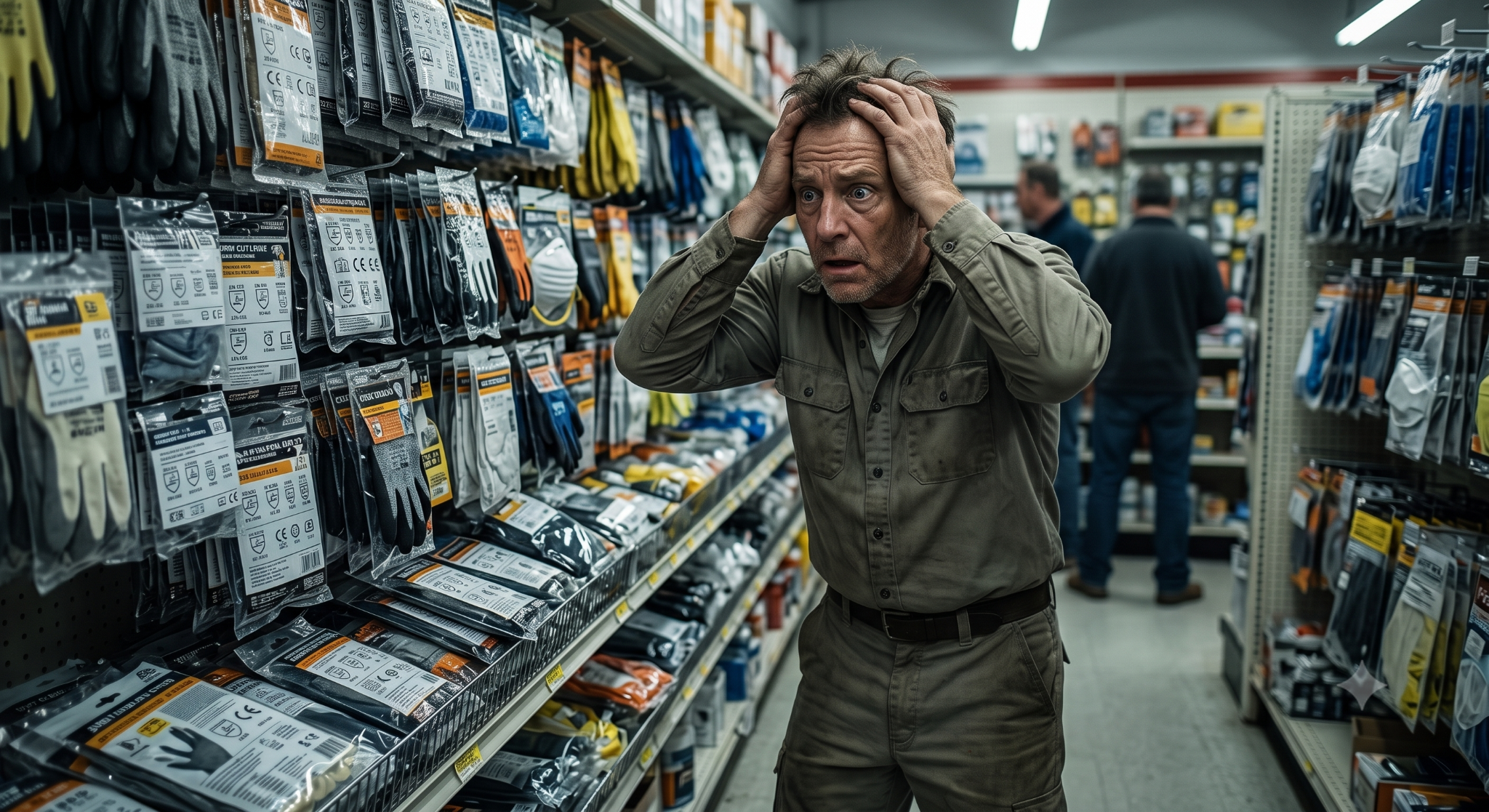
Many retailers still operate under the assumption that a safety glove is a simple, price-driven commodity. They crowd the shelves with dozens of identical-looking options and engage in aggressive price-slashing to capture volume. But as the core principles of retail psychology teach us, if price is the only reason customers choose your product, someone else will always offer it cheaper. True, sustainable category growth doesn't come from overcrowding the aisle, it comes from removing shopper doubt.
To turn your glove department into a high-velocity revenue engine, you must stop talking like a laboratory manual and start answering the practical, human questions your customers are subconsciously asking.
The Jargon Trap vs. The Shopper’s Reality
When a serious DIYer looks at a wall of fifty different safety gloves, they don't think in terms of European Norms or mechanical stress test data. They are trying to solve immediate, practical frustrations. Within seconds, their subconscious is scanning the rack, asking three fundamental questions:
- "Will my hands sweat like crazy after an hour of work?" (The Comfort and Breathability Friction)
- "Can I actually pick up a tiny screw or handle small parts with these on, or will I have to keep taking them off?" (The Sensitivity and Precision Friction)
- "Will I lose my grip and slip when holding a wet tool or an oily pipe?" (The Grip and Safety Friction)
If your shelf layout or packaging requires the customer to guess the answers to these questions, they experience cognitive overload. They either pick the absolute cheapest pair out of frustration, or they simply walk away. A confused shopper rarely buys, and they certainly never trade up to premium, high-margin solutions.
Translating Technical Specs into Buying Confidence
To eliminate this friction, a retailer's shelf communication must act as a self-guided translation mechanism. Instead of forcing the shopper to decode technical symbols, the merchandising architecture should immediately validate their practical needs.
For example, high-performance grip coatings shouldn’t just be labeled as "Micro-Foam Nitrile." The shelf-edge communication should explicitly state: "Oil-Resistant Grip – Perfect for Automotive and Plumbing." A highly precise, premium glove shouldn't hide behind "18-Gauge Liner Tech"; it should be boldly positioned as "Bare-Hand Feel – Easily Handle Small Screws and Nails."

When you restructure the visual hierarchy of the safety aisle to answer these human questions at first glance, the entire buying process becomes effortless. You immediately transition the customer from looking at a transactional expense ("I just need cheap hand protection") to investing in a functional tool ("I am buying precision, comfort, and safety").
Concept-Led Education: Making Staff Support a Bonus, Not a Dependency
The ultimate goal of a high-velocity retail layout is to build a completely self-contained, self-educating system. The packaging, color-coded architecture, and shelf-edge communication must be so flawless that a customer can confidently analyze their options and choose the correct tool entirely on their own. A truly scalable retail strategy should never create an operational dependency on floor staff to explain the inventory; the concept itself must do the heavy lifting.
That being said, well-trained store associates still add immense value, not as a necessary crutch to rescue a confused shopper, but as a high-margin sales catalyst. When the intuitive layout handles the baseline customer education, staff members don't need to recite intimidating technical data. Instead, they can focus on simple, task-based validation. A brief exploratory question like, "Are you working with sharp metal today, or handling dry wood?" doesn't replace the self-guided shopping experience; it reinforces it, giving the customer the final nudge of confidence to trade up to a specialized, premium solution.
The Bottom Line
People are still people, and they will always choose the path of least complexity. Your glove aisle shouldn't be a puzzle that your customers have to solve. By partnering with a structured PPE specialist who co-engineers turn-key shelf layouts, intuitive color-coded architectures, and benefit-driven signage, you replace confusion with instant confidence. When you make choosing natural, you don't just protect your customers' hands, you maximize your retail revenue and profitability.